
Introduction
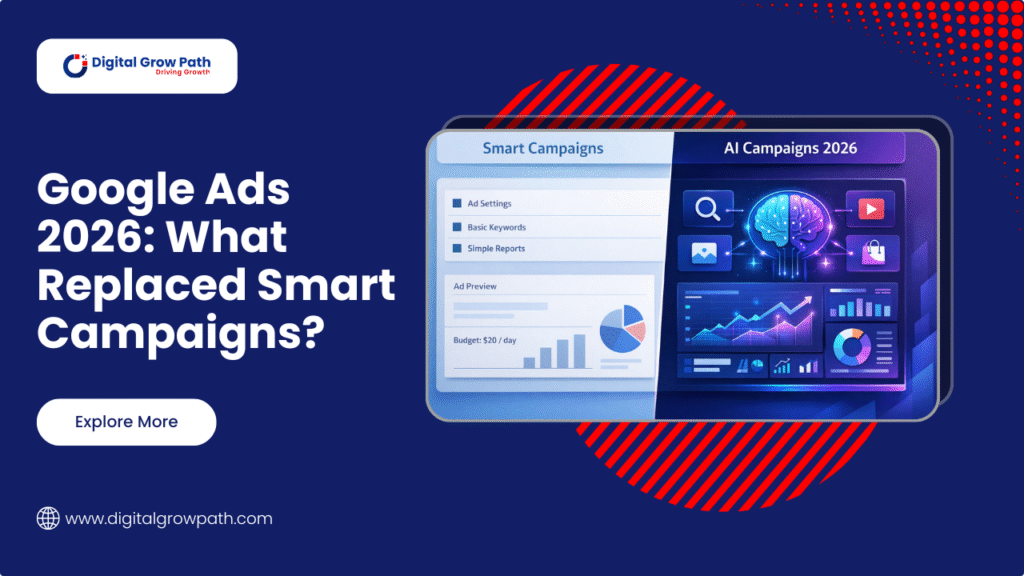
In Google Ads 2026, Smart Campaigns are no longer the default solution for small businesses seeking easy advertising results. For years, Smart Campaigns were Google’s simplified option for quick setup and automated performance—but that has changed.
They still exist, but Google’s focus has clearly shifted toward more powerful, AI-driven campaign types that go far beyond what Smart Campaigns can offer.
So the real question is no longer “Should I use Smart Campaigns?”
It’s “What has replaced Smart Campaigns—and what should I use instead in 2026?”
Let’s break it down.
Why Smart Campaigns Are Losing Relevance
They were built for simplicity:
- One campaign
- One ad group
- Limited keyword themes
- Automated bidding and targeting
- Very basic reporting
This worked when advertising was mostly about getting clicks or calls.
But Google Ads in 2026 is no longer just about traffic. It’s about:
- AI-driven intent prediction
- Lifetime value (LTV), not just leads
- Cross-channel visibility (Search, YouTube, Display, Discover, Gmail)
- First-party data, consent mode, and enhanced conversions
It simply can’t support this level of sophistication.
That’s why Google is quietly pushing advertisers toward newer campaign types that use the same “easy setup” philosophy—but with far more intelligence and reach.
What Has Replaced Smart Campaigns in 2026?
1. Performance Max (PMax) — The True Successor
If Smart Campaigns were “automation v1,” Performance Max is automation v3.
Performance Max campaigns:
- Run across Search, Display, YouTube, Discover, Gmail, and Shopping
- Use AI to decide where, when, and how ads appear
- Optimize for conversion value, ROAS, or leads
- Accept rich audience signals instead of manual keywords
Why PMax replaces Smart Campaigns:
- One campaign replaces multiple channels
- Better optimization using real conversion data
- Now includes channel-level reporting (introduced in late 2025)
- Supports A/B testing (beta) for assets
In 2026, PMax is the default “smart” campaign for businesses that want scale, not just basic visibility.
2. Demand Gen — For Awareness + Performance Together
They were never good for brand building or mid-funnel engagement.
That gap is now filled by Demand Gen.
Demand Gen campaigns:
- Replace Video Action Campaigns and Discovery Ads
- Run on YouTube, Discover, and Gmail
- Focus on high-impact visuals and video
- Support Target CPC, New Customer Acquisition, and AI-generated creatives
Why Demand Gen matters in 2026:
- Brand and performance are no longer separate
- Visual storytelling directly impacts conversions
- Short-form video and shoppable content dominate attention
If Smart Campaigns were “set and forget,” Demand Gen is “inspire and convert”—powered by AI.
3. AI Max for Search — Smarter Than Smart Campaigns Ever Were
It relied on keyword themes.
AI Max takes that idea much further.
AI Max:
- Expands beyond your keyword list automatically
- Shows ads for relevant queries you didn’t explicitly target
- Dynamically adjusts ad copy and landing pages
- Integrates with Google’s AI Overviews in Search
Key difference from Smart Campaigns:
- Works on top of standard Search campaigns
- Gives you more reach with better intent matching
- Requires active monitoring of search terms and negatives
In 2026, Search is no longer just keywords—it’s intent signals.
Smart Campaigns vs Modern Google Ads Campaigns
| Feature | Smart Campaigns | Modern Campaigns (PMax, Demand Gen, AI Max) |
| Setup | Very basic | Guided but strategic |
| Control | Minimal | Strategic inputs, AI execution |
| Channels | Limited | Full Google ecosystem |
| Reporting | Simplified | Channel & asset-level insights |
| Optimization | Clicks & calls | Revenue, LTV, profit |
| Future-ready | ❌ | ✅ |
Should You Still Use Smart Campaigns in 2026?
They still make sense only if:
- You’re a very small local business
- You want basic calls or visits
- You don’t track conversions properly
- You don’t have time or expertise to manage campaigns
For everyone else:
- eCommerce brands
- Service businesses
- Lead-gen companies
- Agencies
- Growth-focused founders
This campaign type is a limitation, not a shortcut..
What Google Really Wants You to Do in 2026
All Google Ads updates point in one direction:
- Trust AI with execution
- Focus humans on strategy, data, and creative
- Feed the system high-quality signals, not micromanagement
Conclusion
They are no longer the driving force behind Google Ads in 2026. While they still exist for very small businesses with basic needs, Google’s real focus has clearly shifted toward advanced, AI-powered campaign types like Performance Max, Demand Gen, and AI-driven Search. Advertising success is no longer about manually controlling keywords or bids, but about feeding the system high-quality data, clear business goals, and strong creatives. Automation and AI now handle execution, while advertisers must focus on strategy, conversion quality, and long-term value. Businesses that continue to rely only on Smart Campaigns risk limiting growth, visibility, and profitability. To stay competitive in 2026, advertisers need to move beyond “set-and-forget” campaigns and embrace smarter systems that optimize across the full customer journey—from discovery to conversion and beyond.